
LP1501 PoE Door Controller (ADC-AC-LP1501) - Installation Guide
Note: This article specifically covers the installation of the LP1501 PoE Door Controller (ADC-AC-LP1501). For instructions on how to set up a broader access system, see Smarter Access Control - Quick Start Guide.
The LP1501 PoE Door Controller (ADC-AC-LP1501) provides local decision making, event reporting, and database storage capabilities for the Alarm.com Smarter Access Control platform. Two reader interfaces provide control for one supervised physical barrier or two unsupervised physical barriers.
For UL compliance, the Power Sourcing Equipment (PSE), such as a PoE enabled network switch and/or PoE power injectors, must be UL Listed under UL294B.
LP1501 PoE Door Controller
Reader port 1 can accommodate a Wiegand or OSDP reader and provides LED and buzzer control. This port can alternatively utilize a two-wire RS-485 bus to connect up to eight Mercury series expansion modules. Reader port 2 can only accommodate a Wiegand reader and provides LED and buzzer control.
Two Form-C contact relay outputs may be used to control locking hardware. The relay contacts are rated at 2 A @ 30 VDC, dry contact configuration. The two inputs that are provided may be used for monitoring door position switches or request-to-exit devices. Input circuits can be configured as unsupervised or supervised. The LP1501 requires Power over Ethernet (PoE), PoE+, or 12 VDC for power.
The LP1501 may be mounted in a 3-gang switch box, on the provided mounting plate, or in an enclosure. The mounting plate included in the Power Supply Kit has mounting holes that match the ADC-ACX1 (ADC-AC-MR50) mounting footprint.
The SRAM is backed up by a rechargeable battery when input power is removed. This battery should retain the data for a minimum of 3 days. If data in the SRAM is determined to be corrupt after power up, all data, including flash memory, is considered invalid and is erased. All configuration and cardholder data must be re-downloaded.
The initial charge of the battery may take up to 48 hours to be fully charged.
LP1501 hardware

Wiring and DIP switch setup
Connections
| Terminal | Label | Function |
|---|---|---|
|
TB1-1 |
IN1 | Input 1 |
| TB1-2 | IN1 | Input1 |
|
TB1-3 |
IN2 | Input 2 |
| TB1-4 | IN2 | Input 2 |
| TB2-1 | VO | Reader 1 Power Output – 12 VDC |
| TB2-2 | LED | Reader 1 LED Output |
| TB2-3 | BZR | Reader 1 Buzzer Output |
| TB2-4 | CLK | Reader 1 CLK/Data 1/TR+ |
| TB2-5 | DAT | Reader 1 DAT/Data 0/TR- |
| TB2- 6 | GND | Reader 1 Ground |
| TB3-1 | LED | Reader 2 LED Output |
| TB3-2 | BZR | Reader 2 Buzzer Output |
| TB3-3 | CLK | Reader 2 CLK/Data 1 Input |
| TB3-4 | DAT | Reader 2 DAT/Data 0 Input |
| TB4-1 | VO | Auxiliary Power Output – 12 VDC |
| TB4-2 | GND | Auxiliary Power Output Ground |
| TB4-3 | VIN | Input Power – 12 VDC (from local power supply) |
| TB4-4 | GND | Input Power Ground |
| TB5-1 | NO | Relay K1 – Normally Open Contact |
| TB5-2 | 1-C | Relay K1 – Common Contact |
| TB5-3 | NC | Relay K1 – Normally Closed Contact |
| TB5-4 | NO | Relay K2 – Normally Open Contact |
| TB5-5 | 2-C | Relay K2 – Common Contact |
| TB5-6 | NC | Relay K2 – Normally Closed Contact |
Jumpers
| Jumpers | Set At | Description |
|---|---|---|
| J3 | PoE | LP1501 powered from the Ethernet connection |
| 12V | LP1501 powered from a local 12 VDC power source connected to TB4-3 (VIN), TB4-4 (GND) |
|
| J7 | Cabinet tamper switch input: short = tamper secure |
DIP switches
The four DIP switches determine the operating mode of the ADC-AC-LP1501 processor. DIP switches are read on power-up except where noted on the page below.
Normal operation mode (all DIP switches in off position)
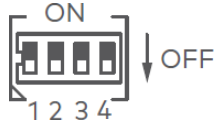
Note: Controllers are shipped with all DIP switches in the ON position. Before powering the controller on, set all DIP switches to the OFF position to use the Normal Operating Mode.
For information about DIP switch configuration, see What are the DIP switches used for on a PoE Door Controller?.
24 VDC and 12 VDC power supplies

12 VDC power supply

Status LEDS
Power-up
All LEDs OFF
Initialization
LEDs 1, 2, 3, 4, 5, 6, and 7 are sequenced during initialization. LEDs 1, 3, and 4 are turned ON for approximately 1.5 seconds after the hardware initialization has completed, then the application code is initialized. The amount of time the application takes to initialize depends on the size of the database. When LEDs 1, 2, 3 and 4 flash at the same time, data is being read from or written to flash memory, do not cycle power when in this state.
If the sequence stops or repeats, perform the Factory Reset procedure.
Running
| LED | Description |
|---|---|
| 1 |
Connecting to Alarm.com (20% on, 80% off)
Note: If you are seeing an 80% OFF and 20% ON flash pattern on LED 1, the controller is OFFLINE. For assistance, see Door Controller Networking. 80% ON and 20% OFF means the controller is ONLINE. |
| 2 | Alarm.com Communication Activity |
| 3 | Readers/Expansions:
|
| 4 | Input IN1 Status:
|
| 5 | Input IN2 Status:
|
| 6 |
Cabinet Tamper:
|
| 7 | Reserved |


*Note: If this input is defined, every three seconds the LED is pulsed to its opposite state for 0.1 seconds, otherwise, the LED is off.
Factory reset
The Factory Reset function can be used for the following purposes:
- Reset the controller back to the factory settings
- Erase any previously configured static IP settings
- Erase all configuration and cardholder database information
- Recover from database corruption causing ADC-AC-LP1501 board to continuously reboot
Factory reset steps
Caution: Do not remove power during steps 3-7.
- With the LP1501 board powered off, set the S1 dip switches to: 1 & 2 “ON”, 3 & 4 “OFF”.
- Apply power to the LP1501 board. LED 1 will be on for about 15 seconds while the board boots up.
- Watch for LEDs 1 & 2 and 3 & 4 to alternately flash at a 0.5 second rate; LED 1 will be solid for 15 seconds before this occurs.
Important: It may take more than five seconds before this LED pattern appears. Failure to wait for this pattern before proceeding to the next step will result in a canceled factory reset. - Within 10 seconds after the above pattern starts, change switches 1 and 2 to “OFF”.
- If successful, only LEDs 1 & 4 will flash for eight seconds.
- Full memory erase takes up to 60 seconds.
- The LP1501 board will reboot 8 seconds after LEDs 1 & 4 stop flashing (no LEDs are on during this time).
Input power
The ADC-AC-LP1501 may be powered in one of two ways. Use jumper J3 to select the input power source:
• Power over Ethernet (PoE or PoE+) connection, fully compliant to IEEE 802.3af, or
• Local 12 VDC power supply wired to TB4-3 (VIN), TB4-4 (GND)
Reader and Expansion Module wiring
Reader port 1
Reader port 1 can be used to wire one Wiegand reader, one OSDP reader, or up to eight Alarm.com expansion modules using a 2-wire RS-485 bus. The maximum cable length is 2,000 ft. (610 m). Power is supplied to reader port 1 at 12 VDC at 300 mA maximum.
Reader port 2
Reader port 2 can only be used to wire one Wiegand reader. The reader connected to reader port 2 may be powered from the 12 VDC auxiliary power output (TB4-1 and TB4-2).
Readers that require different voltage or have high current requirements should be powered separately. Refer to the reader manufacturer specifications for cabling requirements.
For readers with two LED wires, only connect the wire controlling the green LED to the LP1501.
Caution: When powering expansion modules and peripherals from the ADC-AC-LP1501, be cautious not to exceed 625 mA @ 12 VDC when using PoE or 1.25 A when using PoE+ or a 12 VDC external power supply. 22 AWG minimum is recommended for readers.
Reader wiring diagrams
Reader Port 1: Typical Wiegand Reader
Reader Port 1: Typical OSDP Reader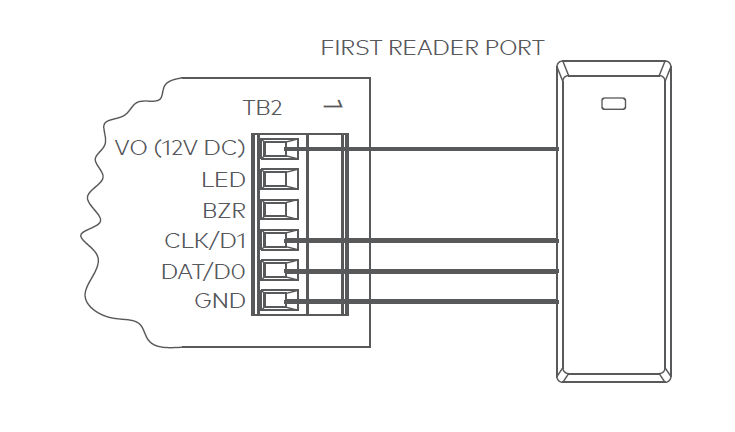.png?revision=1&size=bestfit&width=550&height=323)
Reader Port 2: Typical Wiegand Reader

Reader Port 1: Wiring expansion modules using 2-wire RS-485
Up to eight total expansion modules may be wired. The last expansion module on the bus must have jumper J5 installed for ADC-ACX2 (ADC-AC-MR52) modules and J4 installed for ADC-ACX1 (ADC-AC-MR50) modules. Use twisted pair 24 AWG, 120 ohm impedance cable with drain and shield wires. 2,000 ft. (609 m) maximum total length.

Note: It is recommended to follow best practices for rs-485 wiring (i.e., daisy chain the expansion modules together). It is not recommended to use a star wiring topology when wiring expansion modules.
Relay wiring
Two Form-C contact relays are provided for controlling door lock mechanisms. The relay contacts are rated at 2A @ 30V DC, dry contact configuration. Each relay has a Common pole (C), a Normally Open pole (NO), and a Normally Closed pole (NC).
When momentarily delivering power to unlock the locking hardware (fail secure), the Normally Open and Common poles are used. When momentarily removing power to unlock the locking hardware (fail safe), the Normally Closed and Common poles are used. Check with local building codes for proper egress door installation.
Caution: Door lock mechanisms can generate EMF feedback to the relay circuit that can cause damage and premature failure of the relay. For this reason, it is recommended that either a diode or MOV (metal oxide varistor) be used to protect the relay.
From the Auxiliary output, the ADC-AC-LP1501 can provide 12 VDC power for external devices provided power specifications are not exceeded (i.e., 625 mA when using PoE or 1.25 A when using PoE+ or a 12 VDC external power supply). See the Specifications section for details. If a local power supply is used, it must be UL Listed Class 2 rated. 18 AWG minimum recommended for electric locking hardware.
Relay circuit wiring diagrams
Door strike
An electrified door strike replaces a traditional door strike for an Access Control system. Door strikes are predominantly Fail-Secure devices, meaning the door remains secure in the event power is removed. This hardware should be wired as Normally Open using an NO terminal as indicated on Fail-Secure wiring diagram above. This is because entry through the door is only granted when the controller is signaled to close the circuit which energizes the strike and allows entry.
Door lock mechanisms can generate EMF feedback to the relay circuit that can cause damage and premature failure of the relay. For this reason, it is recommended that either a diode or MOV (metal oxide varistor) be used to protect the relay. The wire should be of sufficient gauge to avoid voltage loss.
Diode selection:
Maglock
An electromagnetic lock or maglock is a is an electromagnet which mounts on a door frame, with a steel armature mounted on the door. Maglocks are Fail-Safe only devices. This means that when power is removed or in the event of a fire alarm input (FAI) signal the maglock unlocks the door as required by code. This hardware should be wired as Normally Closed using an NC terminal as indicated on the Fail-Safe diagram above. This is because constant flowing power is required to keep the maglock energized to secure the door.
MOV selection:
Input wiring
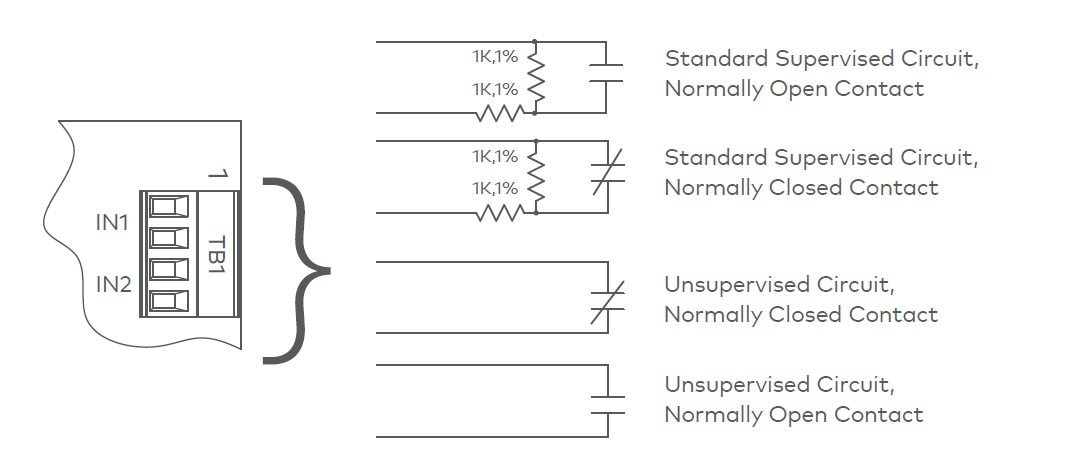
Inputs are used to monitor door position switches or request-to-exit devices. Input circuits can be configured as unsupervised or supervised. When unsupervised, reporting consists of only the open or closed states.
When configured as supervised, the input circuit will report not only open and closed but also open circuit, shorted, grounded*, and foreign voltage*. A supervised input circuit requires two resistors be added to the circuit to facilitate proper reporting. The standard supervised circuit requires 1k ohm, 1% resistors, and should be located as close to the sensor as possible.
*Grounded and foreign voltage states are not a requirement of UL 294 and therefore not verified by UL.
22 AWG minimum required for input wiring. 18 AWG recommended if wiring request-to-exit devices in series with locking hardware.
The input circuit wiring configurations shown are supported but may not be typical:
Specifications
The interface is for use in low voltage, Class 2 circuits only.
The installation of this device must comply with all local fire and electrical codes.
| Input power | PoE/PoE+ or 12 VDC, 1.8 A max |
|---|---|
| Output power |
|
| Inputs | One dedicated reader input One switchable reader/two-wire RS-485 input Two programmable inputs One dedicated tamper input |
| Outputs | Two relay outputs (2 A @ 30 VDC) Single-wire LED control Single-wire buzzer output |
| Certifications | HSPD-12/FIPS201 compliant UL 294 and UL 294B recognized ROHS FCC Part 15 Class A NIST certified encryption |
| Dimensions (WxLxH ) | Without Bracket: 5.5 x 2.75 x 0.96” (140 x 70 x 24 mm) With Bracket: 5.5 x 3.63 x 1.33” (140 x 92 x 34 mm) |
| Temperature | 32 – 158°F (0 – 70°C) operational -67 – 185°F (-55 – 85°C) storage |
| Operating humidity | 5-95% (non-condensing) RH |