What is WebRTC end-to-end video streaming?
WebRTC is one type of technology that Alarm.com uses to establish a connection between a camera and a customer device. It is supported by all major browsers and is widely used in real-time communication applications, including Google Meet and Microsoft Teams.
Compatibility requirements
WebRTC end-to-end streaming requires one of the following video devices with firmware 0.6.7.852+ when using the Alarm.com customer website, or firmware 0.6.6.770+ when using the Alarm.com app:
- 1080p Indoor Wi-Fi Camera (ADC-V516)
- 1080p Indoor Wi-Fi Camera (ADC-V523/523X)
- 4MP Indoor Wi-Fi camera with Integrated Spotlight (ADC-V530)
- 1080p Outdoor Wi-Fi Camera (ADC-V723/723X)
- 1080p Outdoor Wi-Fi Camera with Two-Way Audio (ADC-V724/724X)
- 4MP Outdoor Spotlight Camera (ADC-V730/VC730P)
- 1080p Mini-Bullet Camera (ADC-VC727P)
- Pro Series 1080p Dome PoE Camera (ADC-VC827P)
- Pro Series 4MP Bullet PoE Camera with Varifocal Lens (ADC-VC728PF)
- Pro Series 4MP Varifocal Turret Camera (ADC-VC838PF)
- Pro Series 1080p Dome PoE Camera with Varifocal Lens (ADC-VC847PF)
- 4MP Outdoor Camera Floodlight (ADC-V729/V729AC/VC729P)
- Prism Series 8MP Varifocal Bullet PoE Camera (ADC-VC7398PA)
- Prism Series 8MP Varifocal Dome Camera (ADC-VC8498PA)
- Prism Series 8MP Fixed Dome Camera (ADC-VC8498P)
- Prism Series 5MP Fixed Dome Camera (ADC-VC8295P)
- Alarm.com Premium Video Doorbell Camera (ADC-VDB775)
- 4MP Indoor/Outdoor Battery Camera with Two-Way Audio and Integrated Spotlight (ADC-V731B)
WebRTC connection types
There are three different types of WebRTC connections used with Alarm.com devices, depending on the network conditions between the camera and the customer's device. The types of connection are as follows (in the order in which they are attempted):
- WebRTC Direct connection
- WebRTC Relayed connection
- WebRTC Proxy connection
Each type of WebRTC connection provides a slightly different customer experience which is described in the following sections. Understanding how each connection type affects the customer experience is important.
Note: There are different icons for each streaming method in the Alarm.com customer website, and it may take a few minutes to configure the WebRTC live stream and for the icon to appear. The WebRTC streaming method icon does not appear when using Log In with Access without video access.
WebRTC Direct connection
WebRTC Direct connection is a peer-to-peer connection in which a direct connection has been established between a camera and a customer's viewing device (e.g., mobile phone or laptop).
Because the streams don't have to go through an intermediary server, this type of connection allows users to stream for an unlimited amount of time. In other words, the streams won't time out unless an adverse network condition occurs and the connection is interrupted. This type of connection is attempted first and is successful roughly 60-70% of the time. A Direct connection is most likely to succeed in simple network environments, such as residential homes.
When WebRTC Direct streaming is active,  will appear on the camera live stream. Mouse over the icon to display the message: Continuous streaming connected.

Topology limitations
Connecting Alarm.com cameras downstream from a Stream Video Recorder (i.e., connected through the PoE ports or Camera port) may impact the ability to achieve a WebRTC Direct connection in certain configurations. If the cameras are connected upstream from the SVR (i.e., on the same network), they should be capable of maintaining a WebRTC Direct connection. To attempt to force a WebRTC Direct connection, proceed to To force a WebRTC Direct connection stream.
Compatible third-party cameras should be able to achieve WebRTC Direct streaming whether they are installed downstream or upstream from the Stream Video Recorder.
WebRTC Relayed connection
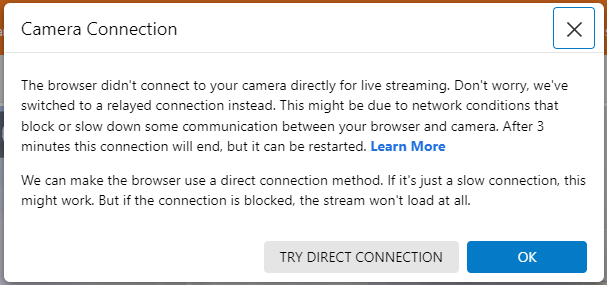
A WebRTC Relayed connection is used when a Direct connection between the camera and the customer's viewing device (e.g., mobile phone or laptop) cannot be established. This typically occurs due to network conditions such as firewalls, certain Network Address Translation (NAT) configurations, or other connectivity restrictions. To resolve this, WebRTC will relay the video and audio stream through an intermediary server on a public network. With this method, a time out period of 15 minutes is enforced for live view. This type of streaming is attempted second and makes up roughly 30% of total streams.
When WebRTC Relayed connection streaming is active,  will appear on the camera live stream. Mouse over the icon to display the message,Stream will time out in 15 minutes.

WebRTC Proxy connection
WebRTC Proxy connection means that attempts to establish a Direct or Relayed connection have failed. Like a Relayed connection, a Proxy connection relays media through an intermediary server and has a time out period of 3 minutes. This type of connection accounts for roughly 5% of total streams.
Currently, customers do not have audio access to their camera while on a Proxy connection. However, Remote Video Monitoring (RVM) operators have audio access and can have Two-Way Audio conversations.
For cameras that support WebRTC Direct or Relayed connections but are streaming over WebRTC Proxy,  will appear in the feed. Mouse over the icon to display the message, Unable to connect to continuous streaming.
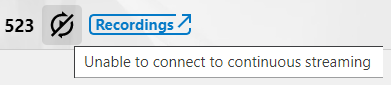
For cameras that do not support WebRTC Direct or Relayed connections, and can only stream over proxy, no icon will appear on the stream.

Change connection types
In instances where a Direct connection is desired and was not initially successful, customers can attempt to force a Direct connection.
To force a WebRTC Direct connection stream:
- Log in to the Alarm.com customer website.
- Click Video.
- On the Live Video or SVR Timeline pages, mouse over a camera live stream.
- Click on the stream-type indicator icon
 or .
or . - In Camera Connection, click Try Direct Connection.